Launch offer — valid today only

Medical Coding Certification Exam: From the Note to the Code in the Same 5 Steps, Every Time Every Concept Drawn on Its Own Page

Excludes1 and Excludes2, the 7th character, the global package, visit levels and modifiers. In your notes it's a wall of text. Here every concept gets its own page: the drawing and what to remember. 61 drawn pages.

YES, I WANT THE 5-STEP METHOD

🔒 Secure checkout · PDF by email · 30-day guarantee

Every concept on its own pagethe drawing shows you the rule and the text backs it up
61 drawn pages8 parts, from the three code books to your one-page review
Up-to-date sourcesICD-10-CM Official Guidelines (CMS and NCHS) and your code book's section guidelines

This Is What the Pages You Will Study Look Like

Every concept gets its own page: the drawing that shows you how it's done and the boxes with what you need to know:

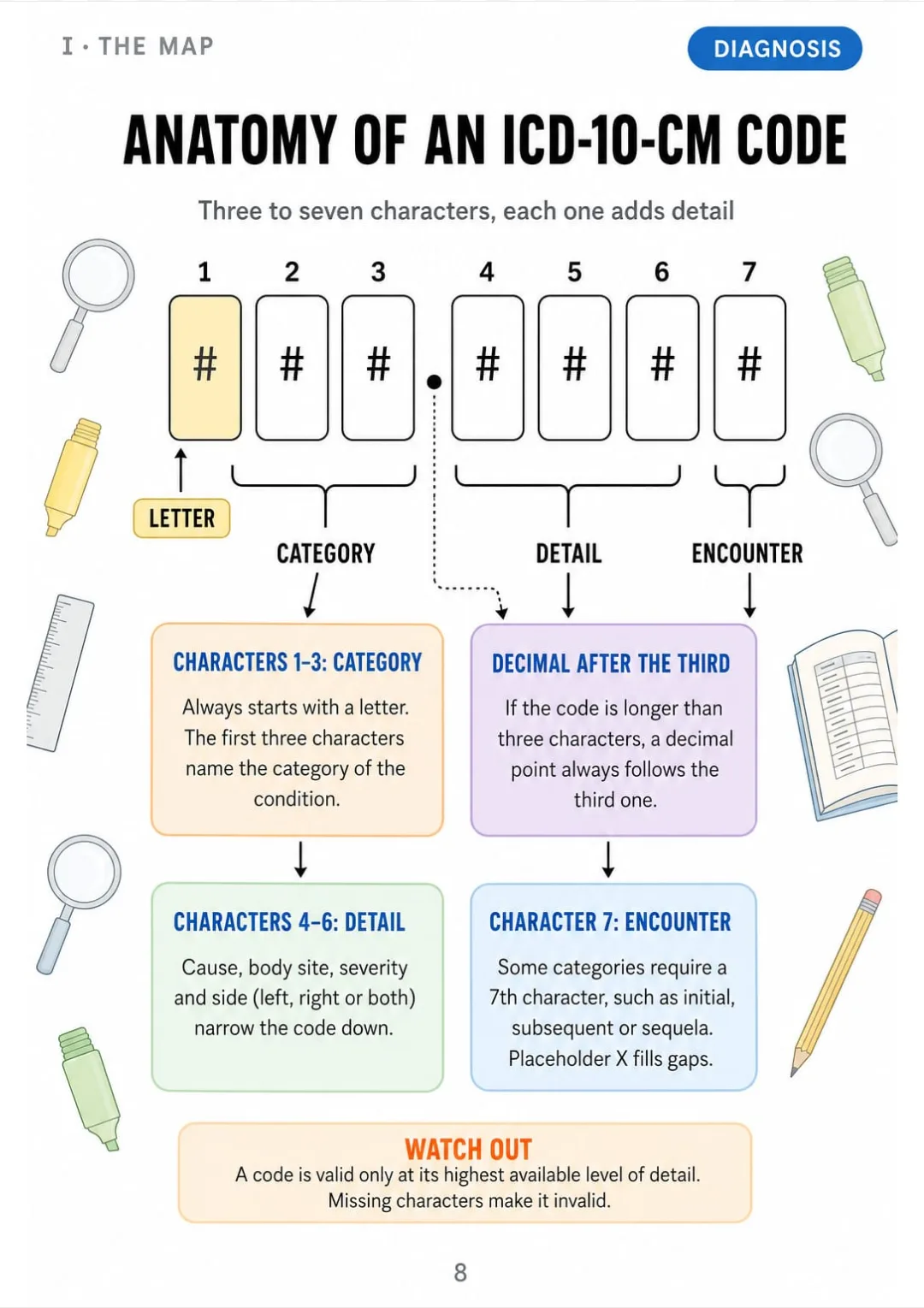
3 to 7 characters, letter first, decimal after the 3rd, 7th = encounter
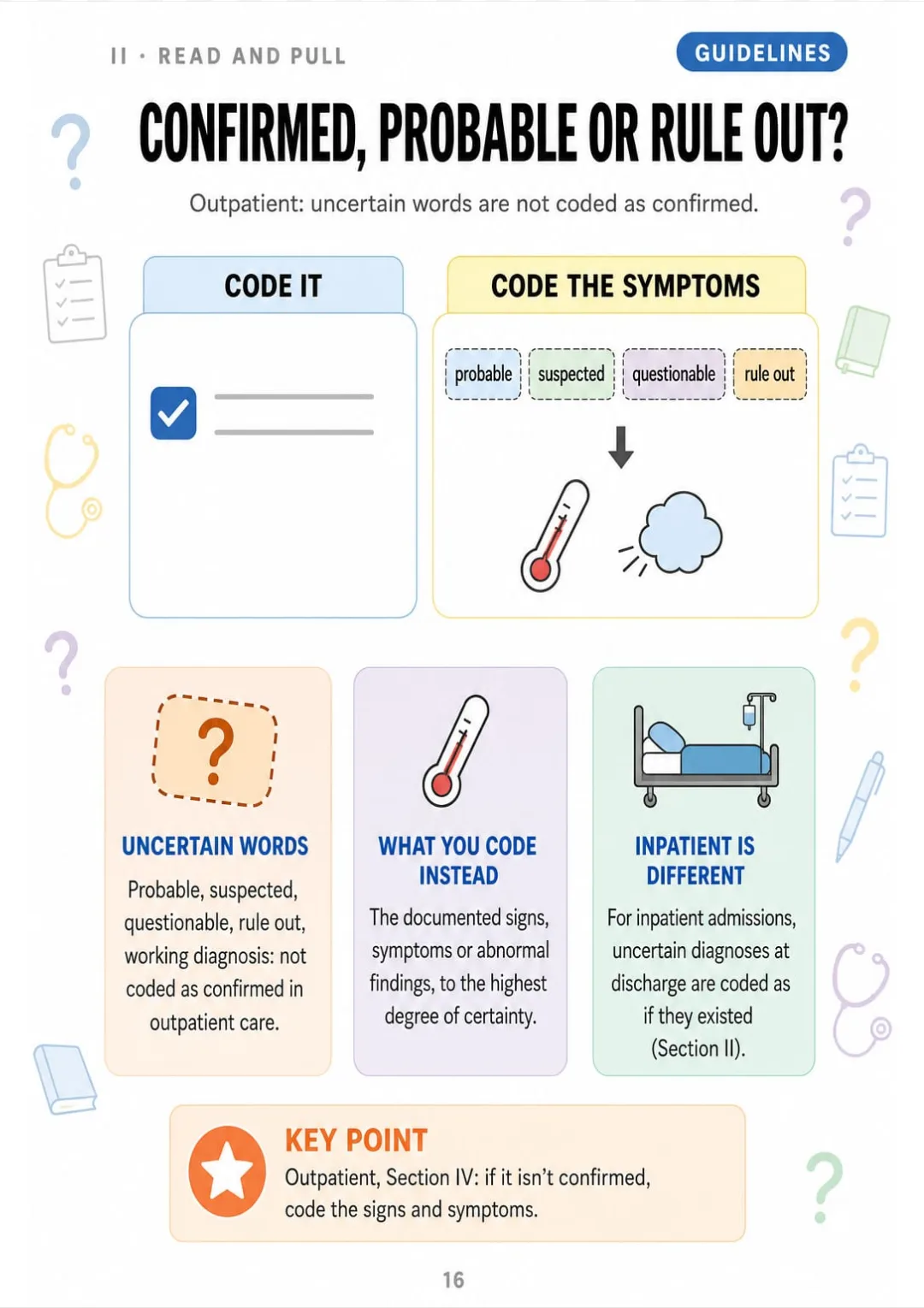
Probable, suspected, rule out: outpatient, you code the signs and symptoms (Section IV).
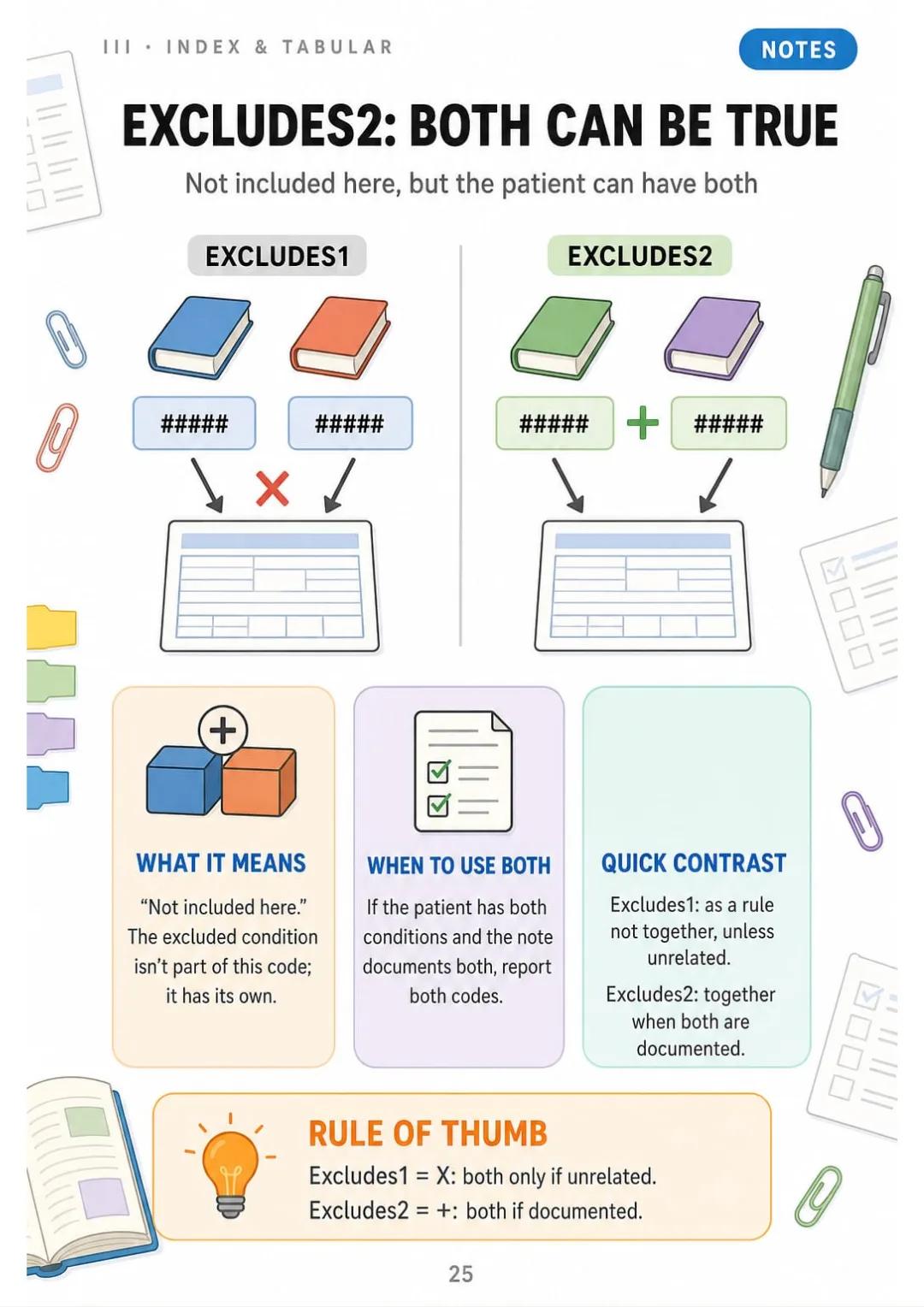
Excludes2 = NOT INCLUDED HERE: report both codes when both are documented
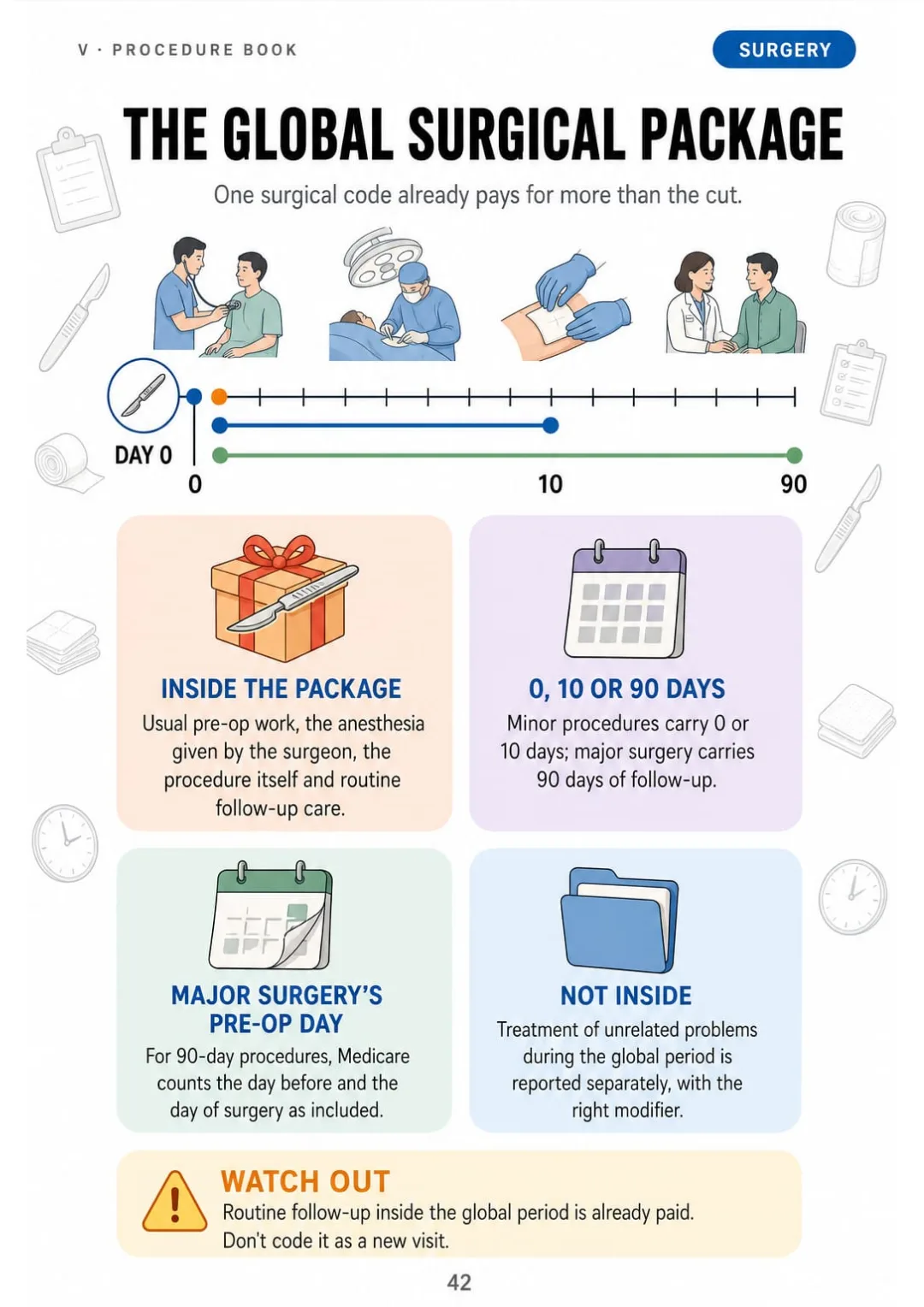
Global periods of 0, 10 or 90 days: routine follow-up is already paid.
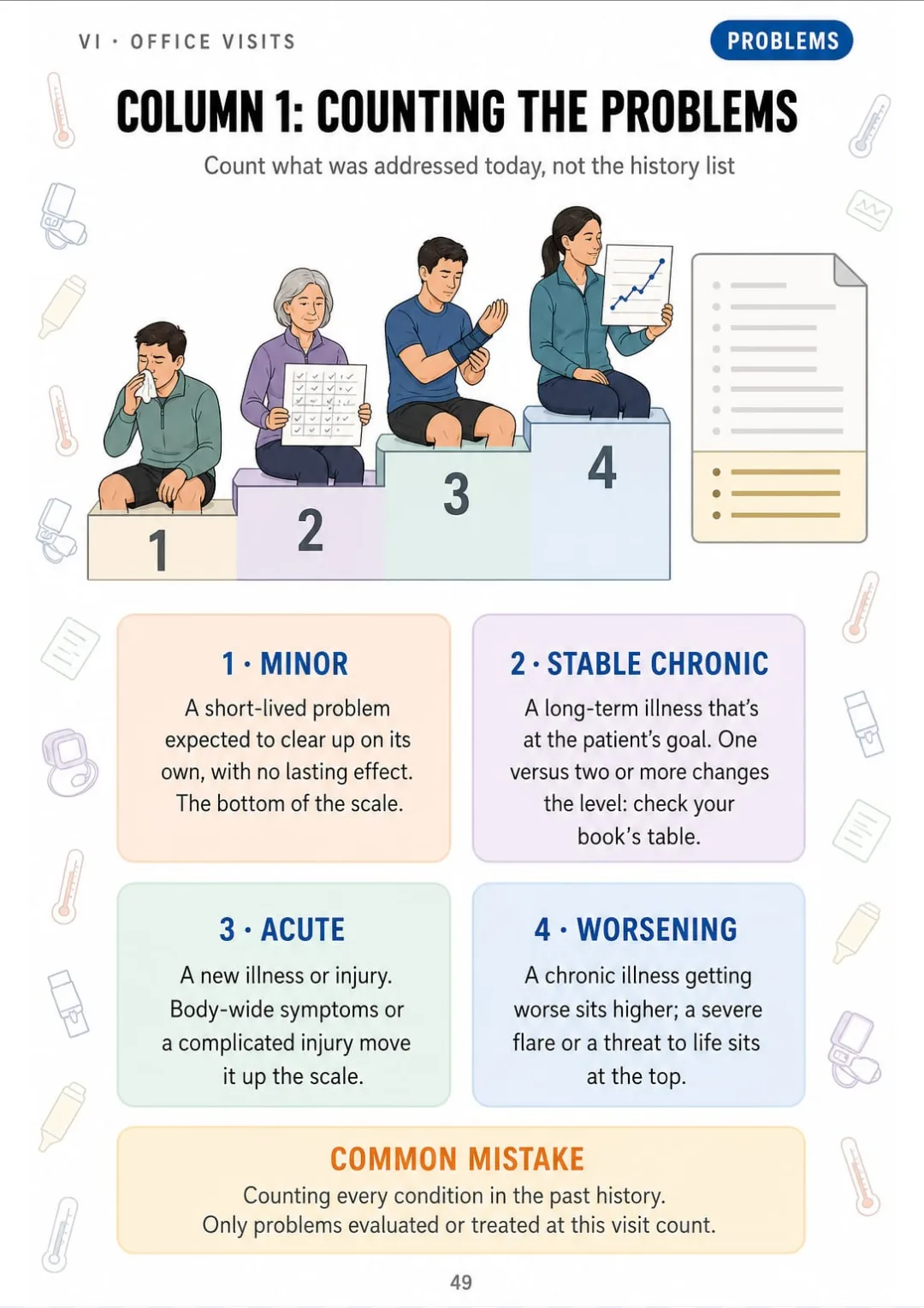
Count only problems addressed today, then use your table.
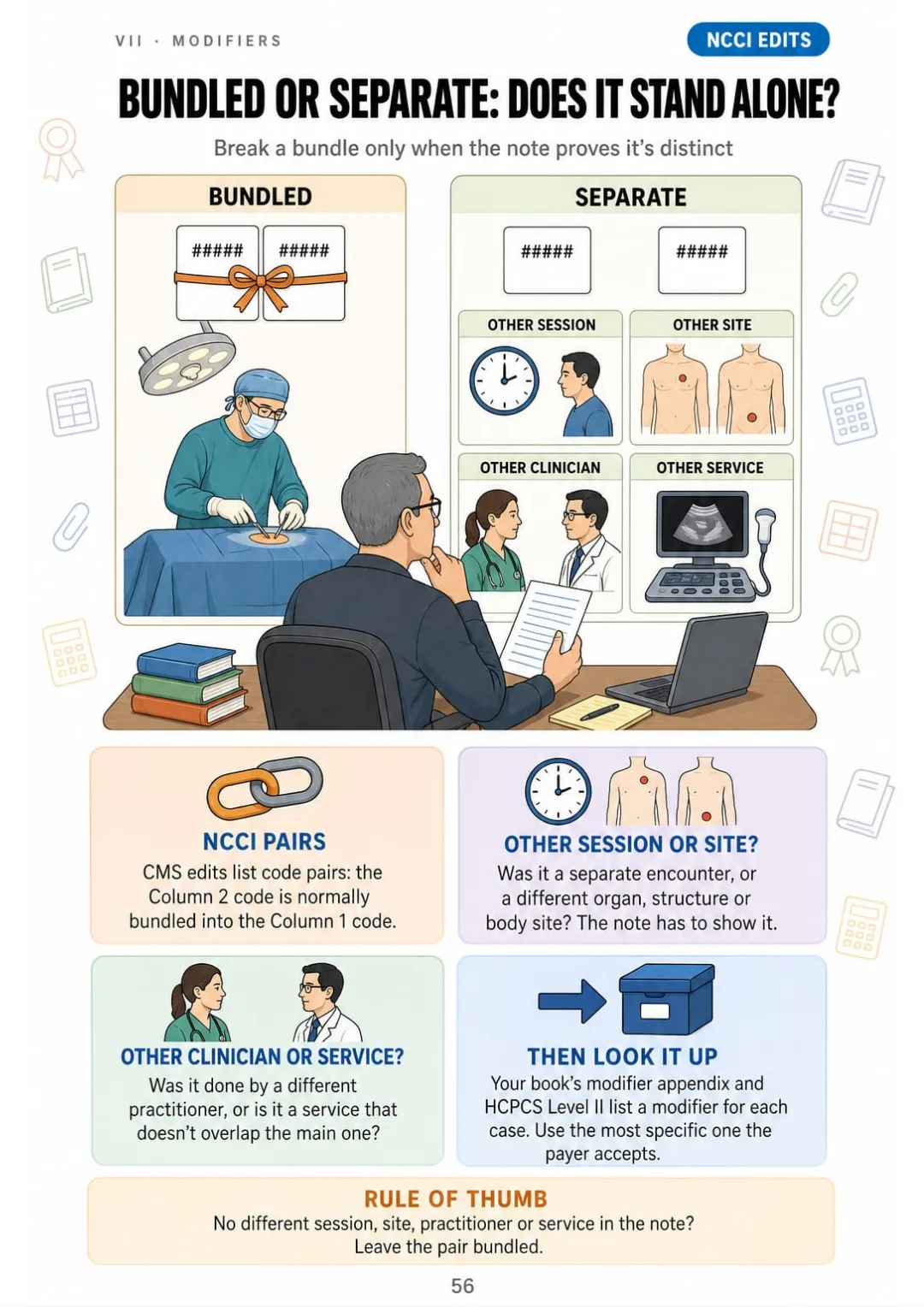
Bundled code pairs; unbundle only with proof of a different session, site, clinician or service
Tab four places: section guidelines, the index, the E/M tables and the modifier appendix

Swipe to see more →

These are real pages from the book. The table of contents is the full one: 8 parts and 61 topics.

It's Not That Your Memory Is Bad. It's That No One Put It in Order for You.

You've read the Excludes1 and Excludes2 notes three times. You close your notes...

...and you can't remember which one lets you report both codes. It was just one line after another.

Excludes2 = NOT INCLUDED HERE: report both codes when both are documented

Here Excludes1 and Excludes2 are two drawings side by side, with the rule in a box under each one and the two codes that can or can't go together.

And on the pages next to it, every convention gets its own: the main term in the index, NEC and NOS, the placeholder X, the 7th character and "code also."

First you understand why it works that way. Then the order stays with you on its own.

SEE THE DIFFERENCE

Stop memorizing guidelines you can't picture:

THIS
  • Pages and pages of tight text
  • Guidelines without a single drawing
  • On the exam, you don't know where to start
An Excludes2 note indicates that the condition excluded is not part of the condition represented by the code, but a patient may have both conditions at the same time. When an Excludes2 note appears under a code, it is acceptable to use both the code and the excluded code together, when appropriate, provided the documentation supports each condition and the applicable sequencing instructions, conventions and chapter-specific guidelines have been reviewed and applied in conjunction with the Alphabetic Index and the Tabular List.
FOR THIS
  • Every guideline drawn
  • Every concept on its own page, rules in boxes
  • You remember it because you've seen it
Probable, suspected, rule out: outpatient, you code the signs and symptoms (Section IV).
CONTENTS

Take a Look at the 8 Parts and 61 Topics

The map before the first note, reading the note, index and tabular list, the guidelines that change the answer, the procedure book, office visit levels, modifiers and bundling, and exam-day review: 61 drawn pages

IThe Map Before the First Note · pp. 5-11
  1. Three Books, Three Jobs
  2. The Chart-to-Code Path in One Picture
  3. Why the Code Boxes Say #####
  4. What an ICD-10-CM Code Looks Like
  5. What a Procedure Code Looks Like
  6. Outpatient vs. Inpatient: Know Which Rules You're Using
  7. The Exam Clock, Drawn Out
IISteps 1 and 2: Read the Note, Pull What Counts · pp. 12-19
  1. Read the Whole Note Before You Circle Anything
  2. Word Parts That Carry the Code
  3. Directions and Body Planes
  4. The Four Things to Pull from Every Note
  5. Confirmed, Probable or Rule Out?
  6. Symptoms That Belong to the Diagnosis
  7. The Reason for the Visit Comes First
  8. Your Pen Marks: One System, Every Note
IIISteps 3 and 4: Index, Then Tabular List · pp. 20-29
  1. Find the Main Term, Not the Body Part
  2. Parentheses Mean Optional Words
  3. Square Brackets in the Index
  4. Never Stop at the Index
  5. Includes and Excludes1
  6. Excludes2: Both Can Be True
  7. Three Tabular Notes: Code First, Code Also, Use Additional Code
  8. NEC and NOS
  9. The Placeholder X and the 7th Character
  10. Initial, Subsequent, Sequela
IVThe Guidelines That Change the Answer · pp. 30-37
  1. “With” Means Linked
  2. Combination Codes: One Code for Two Facts
  3. Left, Right, Both, Unspecified
  4. Sequela: The Leftover Comes First
  5. Z Codes: When the Reason Isn’t an Illness
  6. External Cause Codes Never Go First
  7. Hypertension and Diabetes: Read the Notes
  8. When the Note and the Guideline Disagree
VThe Procedure Book, Step by Step · pp. 38-45
  1. Read the Section Guidelines First
  2. Four Ways into the Procedure Index
  3. The Semicolon Rule
  4. The Symbols in the Margin
  5. The Global Surgical Package
  6. Skin Lesions and Repairs: Measure in Centimeters
  7. Radiology and Lab: Who Did Which Part
  8. Anesthesia: Base, Time, Condition
VIOffice Visits: Choosing the Level Without Guessing · pp. 46-52
  1. New or Established Patient
  2. Two Ways to Pick an Office Visit Level
  3. Medical Decision Making: Three Columns
  4. Column 1: Counting the Problems
  5. Column 2: Counting the Data
  6. Column 3: Reading the Risk
  7. Picking by Time
VIIModifiers and Bundling · pp. 53-58
  1. What a Modifier Tells the Payer
  2. A Separate Evaluation on the Same Day as a Procedure
  3. Sides and Both Sides: Which Side Was Treated?
  4. Bundled or Separate: When a Second Service Stands on Its Own
  5. Reduced, Repeated, Split
  6. When No Modifier Is the Right Answer
VIIIExam Day and Your Desk: Review · pp. 59-65
  1. Review: The 5 Steps on One Note, Start to Finish
  2. Read the Answer Choices Before the Note
  3. Mark, Skip, Come Back
  4. Tabbing and Marking Your Books
  5. The Most Frequent Slips
  6. The 30-Second Check Before Every Answer
  7. Your Path, Printed: One-Page Review

What If You Could See Each Rule at a Glance?

Picture this:

Instead of rereading half a page about the global surgical package without being able to see it...

...you open the page and find the 0, 10 and 90-day periods drawn as a timeline, with the routine follow-up that's already paid inside each one.

Count only problems addressed today, then use your table.

And the 7th character, sequela, Z codes, the three columns of medical decision making and modifiers turn into drawings and tables you can read at a glance.

You stop repeating and start understanding.

That's exactly what Medical Coding: From Chart to Code does. 8 parts and 61 drawn topics, and at the end the 5 steps on one note, the 30-second check and your path on one printable page.

Because once you see the rule drawn, the order stays.

Here Is What You Get with Medical Coding: From Chart to Code:

Ipp. 5-11

The Map Before the First Note

The three code books and what each one does, the 5-step path in one picture, why the code boxes say #####, what a diagnosis code and a procedure code look like, outpatient vs. inpatient rules and the exam clock.

IIpp. 12-19

Steps 1 and 2: Read the Note, Pull What Counts

Reading the whole note first, word parts, directions and body planes, the four things to pull, confirmed vs. probable vs. rule out, symptoms that belong to the diagnosis, the reason for the visit and one pen-mark system.

IIIpp. 20-29

Steps 3 and 4: Index, Then Tabular List

The main term, parentheses and square brackets, why you never stop at the index, Includes, Excludes1 and Excludes2, code first and code also, NEC and NOS, the placeholder X, the 7th character and initial, subsequent, sequela.

IVpp. 30-37

The Guidelines That Change the Answer

“With” means linked, combination codes, left, right and both, sequela, Z codes, external cause codes, hypertension and diabetes, and what to do when the note and the guideline disagree.

Vpp. 38-45

The Procedure Book, Step by Step

Section guidelines first, four ways into the procedure index, the semicolon rule, the margin symbols, the global surgical package, skin lesions and repairs in centimeters, radiology and lab, and anesthesia.

VIpp. 46-52

Office Visits: Choosing the Level Without Guessing

New or established patient, the two ways to pick a level, the three columns of medical decision making (problems, data and risk) and picking by time.

VIIpp. 53-58

Modifiers and Bundling

What a modifier tells the payer, a separate visit on the same day, sides of the body, bundled vs. separate, reduced, repeated and split services, and when no modifier is the right answer.

VIIIpp. 59-65

Exam Day and Your Desk: Review

The 5 steps on one note start to finish, reading the answer choices first, mark-skip-come-back, tabbing your books, the most frequent slips, the 30-second check and a one-page review.

At the end of the book: The 5 steps on one note, start to finish, and your path on one printable page.


And That Is Not All: 2 More Books, Free

The Red-Pen Note Drills

BONUS 1: «The Red-Pen Note Drills»

Value on its own: US$ 17.90

40 invented visit and procedure notes to mark up with a pen, so you practice the 5 steps before you ever open your code books.

The Second-Look Pages

BONUS 2: «The Second-Look Pages»

Value on its own: US$ 14.90

The most frequent coding slips, each with its own page and the quick check that catches it before you choose an answer.

Medical Coding: From Chart to Code + 2 Free Books

  • Medical Coding: From Chart to Code: 61 drawn pagesUS$ 67.90
  • BONUS 1: The Red-Pen Note DrillsUS$ 17.90
  • BONUS 2: The Second-Look PagesUS$ 14.90
  • High-resolution PDF to printIncluded
Total value US$ 100.70
YOUR PRICE:
US$ 27
You save US$ 73.70
YES, I WANT MEDICAL CODING: FROM CHART TO CODE FOR US$ 27

📄 This is a digital PDF book sent to your email: nothing is printed or shipped.

Secure purchaseEncrypted payment30-day guarantee

PDF by email: Medical Coding: From Chart to Code reaches your inbox as a PDF, and the two free books come by email too. One-time payment, no installments or hidden costs.

Is This Book for You?

You're studying on your own

You're studying on your own

The 5 steps in order, so the index conventions and guidelines stop being forty loose rules. Keep your code books open right next to it.

Your certification exam is coming up

Your certification exam is coming up

A full review in the same order every time, from reading the note to the 30-second check, plus a one-page review to print. Also for a second try.

You already code at a doctor's office

You already code at a doctor's office

A quick review for your desk: rule out vs. confirmed, the global package, visit levels and when no modifier is the right answer.

To Sum Up: Here Is What You Get

US$ 100.70US$ 27
YES, I WANT MEDICAL CODING: FROM CHART TO CODE FOR US$ 27

📄 This is a digital PDF book sent to your email: nothing is printed or shipped.

30DAYS
GUARANTEE

30-Day Guarantee

30-day guarantee: tell us what didn't work and we'll refund 100%.

You have 30 days to try Medical Coding: From Chart to Code and the two bonus books. If it didn't help you study, tell us what didn't work and we'll refund 100% of what you paid. One-time payment, no subscription.

Frequently Asked Questions

How do I get the material?

You get Medical Coding: From Chart to Code as a high-resolution PDF by email, at the address you enter at checkout, to read on your phone or print. The two bonus books also come as PDFs by email: The Red-Pen Note Drills (40 invented notes to practice the 5 steps) and The Second-Look Pages (the most frequent coding slips, each on its own page, for a quick review).

Is it a monthly payment or a one-time payment?

One-time payment. No installments and no subscription.

Who is it for?

For anyone in the U.S. studying for a medical coding certification exam on their own, taking it a second time, or already coding and wanting a visual review. It follows U.S. outpatient coding: ICD-10-CM plus the procedure code book your exam uses. You don't need to know coding first: Part I starts with the three code books. Check the table of contents above.

What sources is it based on?

The method is checked against the ICD-10-CM Official Guidelines for Coding and Reporting, published by CMS and NCHS (U.S. Department of Health and Human Services), and it points you to the guidelines printed at the start of each section of your current-year procedure code book. Codes change every year; that's why the book teaches the steps and leaves the code boxes as #####, so it works with your current books. All charts are invented examples.

Is this official material? Does it include the codes?

No, it isn't official, and it doesn't reproduce code lists or code descriptions. The code boxes are printed as ##### on purpose: you look each code up in your own books, which is the same move the exam asks for.

Can this replace a coding course?

No. It's study and review material, not a course: no certificate, no CEUs, no exam voucher. If you already took a course, this gives you the piece it often leaves out: one fixed order for every note, with each rule drawn on its own page, so you never start a question from scratch. It doesn't replace your current code books, your employer's policies or payer rules.

Are the practice notes the real exam questions?

No. The 40 notes in The Red-Pen Note Drills are invented and written for this book. They aren't official exam questions: they're for practicing the 5 steps.

Can I print it? Can I take it into the exam?

You can print it at home or at a print shop. It's for studying and reviewing: only the code books your exam allows go into the exam room. Check your exam's rules before you write in your books.

What if I don't like it?

30-day guarantee: if it doesn't help you study, tell us what didn't work and we'll refund 100% of what you paid.

One Last Thing Before You Decide...

You don't have to reread the same page hoping this time it sticks.

You don't have to memorize guidelines you can't picture.

And you definitely don't have to walk into the exam not knowing where to start.

One last thing before you decide: you already have the code books. What's missing is the order. Here it's 5 steps, 61 drawn pages and 2 bonus books, as a PDF by email.

One-time payment: US$ 27 · Guarantee: 30 days · PDF by email

YES, I WANT MEDICAL CODING: FROM CHART TO CODE FOR US$ 27

📄 This is a digital PDF book sent to your email: nothing is printed or shipped.